
A CURSE BROKEN

During my bachelor’s degree in electrical engineering, I hit the lowest point of my career. It was entirely self‑inflicted because of my own choices. This came after I had already taken a year drop, a quiet shame in the Indian education system, the kind that isn’t always spoken aloud but hangs over every conversation. Yet somehow, I managed to make things worse. I was now on the verge of getting another year drop in my third year.
Fourteen theory papers stood between me and the final year. Four of them I absolutely could not afford to fail. From the remaining ten, I needed to pass at least five just to survive. Then I failed one of the practical exams, and suddenly survival meant passing six out of ten. Anyone familiar with the system knows what that implies. Among my peers, and even my professors, the verdict was unanimous: a year drop was guaranteed. Given my academic history, there was no evidence to suggest I could turn this around.
What hurt me the most wasn’t the pressure; it was the feeling that no one believed in me. That disbelief crushed me and pushed me to the lowest mental point I’ve ever experienced. Paradoxically, it also became the moment that changed everything for me. Somewhere in that darkness, I arrived at a truth that was liberating: the only person who needed to believe in me was me.
The uncomfortable part? I couldn’t even be angry at others for doubting me. I hadn’t given them a reason to believe in the first place. Belief, I learned, is rarely owed, it’s earned. So I had a personal curse to break, and breaking it was one of the hardest things I’ve ever done. It also taught me the most important lesson of my life: before results change, our identity must. I emerged from that period as a different person. The boy who thought he was a failure began to believe he was capable of doing something meaningful.
That’s why, when I look at Mikel Arteta’s semi‑final record, I see a familiar psychological weight. In my eyes, Arteta has a curse of his own:
One win in nine semi‑finals.
No wins in two‑legged semi‑final ties.
No goals scored in League Cup semi‑finals.
These aren’t just bad outcomes. They’re psychological scars, and scars don’t disappear just because you improve tactically. They sit in the subconscious, waiting for pressure moments to arrive.
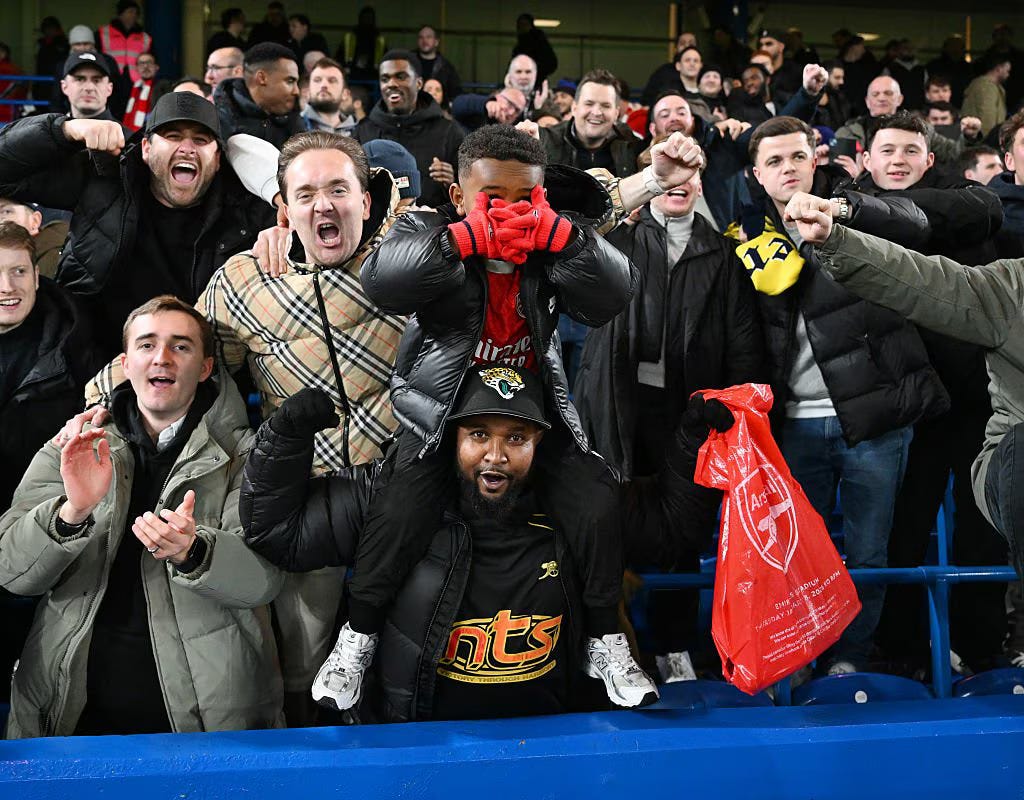
If Arsenal are to become serial winners, these mental barriers must be confronted. Arsenal did exactly that in the Carabao Cup first‑leg semi‑final against Chelsea at Stamford Bridge. The 3–2 scoreline flatters Chelsea, and Arsenal should have had this tie done and dusted. The frustration around missed chances is understandable; the irritation at not killing the game is valid, but context matters.
Before this night, Arsenal hadn’t scored a single goal in a League Cup semi‑final under Arteta. Before this night, Arsenal had never won a game in a two‑legged semi‑final under him. So the task at hand wasn’t to show dominance or ruthlessness. The task was belief — first belief to score a goal, then belief to win the game — and both tasks were achieved.
Viewed through that lens, this was a far bigger victory than it initially feels like. It wasn’t a perfect win, but it crossed a psychological line that had existed for years. Football, at its highest level, is rarely about ability; it’s often about permission —permission that players and managers give themselves to believe that this time will be different. Belief always precedes repetition.
The next evolution for this Arsenal side is developing a killer instinct, especially away from home. Too often under Arteta, our best away performances have ended in narrow one‑ or two‑goal wins when they should have been emphatic, statement victories. That lack of ruthlessness is real, and it will have to be addressed. But you don’t arrive at ruthlessness without first breaking the mental chains.
You don’t dominate before you believe.
You don’t become relentless before you become convinced.
Sometimes the most important victory isn’t the one that looks the best on paper, but the one that quietly tells this group: we can do this.
When the odds are stacked against us and there is doubt from everyone around us, even the voice in our own heads reminds us of past failures. In such instances, the shift isn’t overnight; all we need is just enough belief to take the next step.
This win felt like that. If Arsenal are to lift multiple trophies this season, nights like this— imperfect and frustrating but psychologically freeing — will matter far more than we realize right now. Before we win big, we must first break the curse that tells us we never will.